
Buying Property in Greece: The Complete Guide for International Buyers
A comprehensive guide to the Greek property market, the buying process, legal checks, taxes, financing, residency options and long-term ownership.
Greece offers international property buyers a distinctive combination of Mediterranean living, an extensive coastline, a rich cultural heritage and a diverse real estate market. From contemporary apartments in Athens and seafront homes along the Athens Riviera to traditional island houses, holiday residences and properties with rental potential, the country offers opportunities for a wide range of budgets and objectives.
Yet buying property in another country requires more than finding an attractive home. International buyers must understand the legal framework, establish their tax position, verify the property’s ownership and planning status, calculate the full acquisition costs and consider the practicalities of owning and managing real estate from abroad.
This guide explains how to approach the process methodically, what to investigate before committing funds, which costs to anticipate and how to evaluate a property in the context of your personal or investment objectives.
Whether you are planning to relocate to Greece, purchase a holiday home, diversify your investments or explore the possibility of qualifying for a residence permit through real estate investment, the objective is the same: to make a well-informed decision with a clear understanding of the opportunities, obligations and risks.
Guide review date: 22 October 2026. Immigration, tax and property regulations can change. Before making a transaction, confirm the rules applicable to your circumstances with the relevant Greek authorities and qualified local professionals.
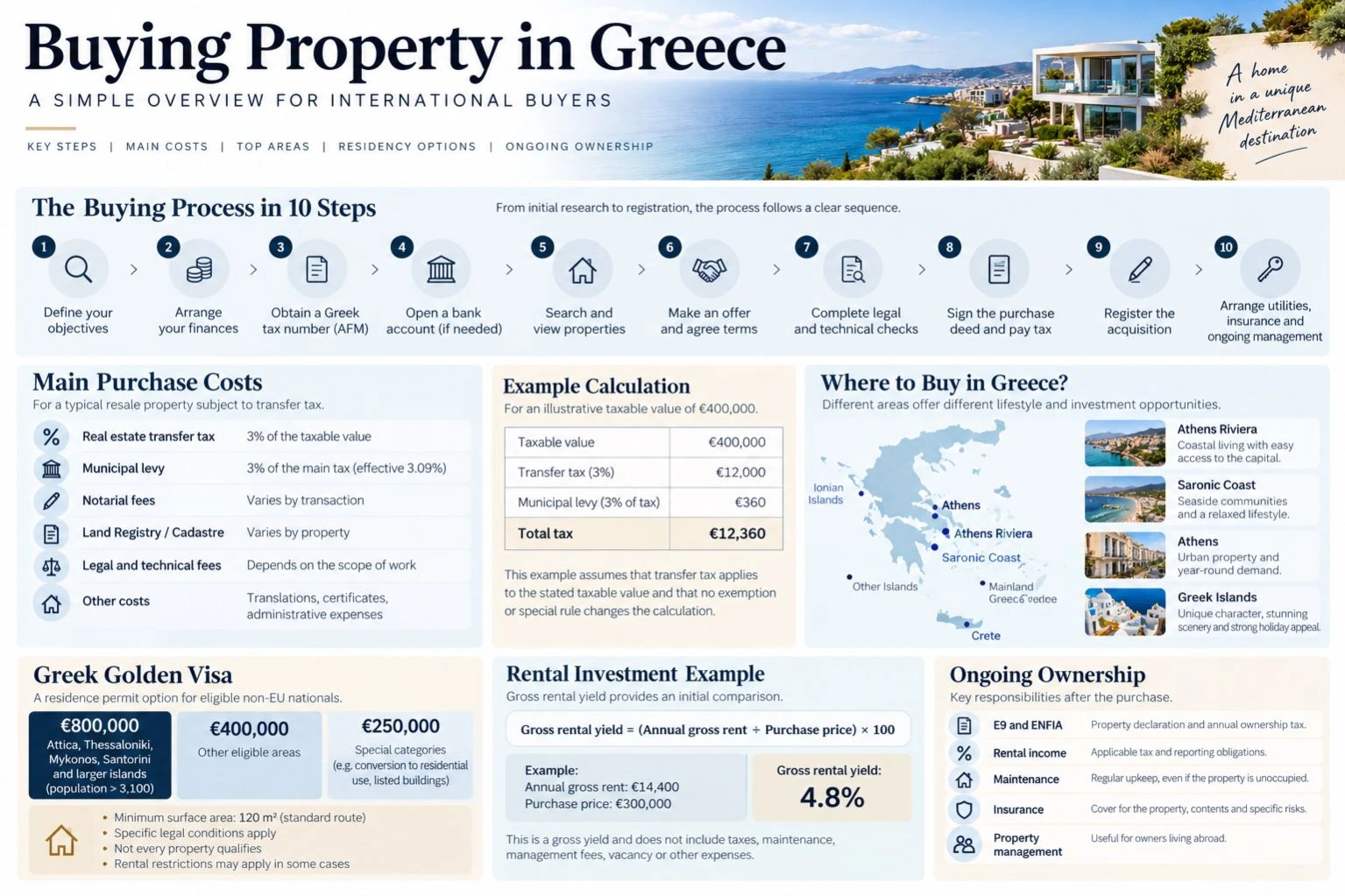
1. Can Foreigners Buy Property in Greece?
Yes. Greece generally allows foreign individuals and companies to acquire real estate, including residential homes, apartments, commercial properties, land and eligible investment properties. However, the exact procedure and any additional restrictions depend on the buyer’s nationality, the property’s location, its intended use and the legal structure of the acquisition.
An important distinction is that the right to purchase property, the right to reside in Greece and the right to work in Greece are three different matters. Buying a home does not automatically grant a foreign national permission to live in Greece indefinitely, nor does it automatically confer tax residency or employment rights.
Buyers from the European Union and the European Economic Area
EU citizens generally benefit from the right to move and reside within the EU, subject to the applicable registration and residence requirements. They can normally purchase property in Greece under the general framework applicable to property ownership.
EEA nationals may benefit from related rights under the relevant agreements. Their individual circumstances should still be checked where specific administrative requirements apply.
Buyers from countries outside the EU
Non-EU nationals can also purchase Greek real estate. However, certain border and strategically sensitive areas are subject to special restrictions or approval procedures for buyers from third countries.
These rules are particularly important when considering property in specific border regions or locations covered by the relevant legislation. The property’s exact location and the buyer’s legal status should be checked before signing a binding agreement or transferring substantial funds.
Non-EU buyers should also consider how their intended length of stay, nationality, tax residence and any planned rental activity affect their broader plans.
Can a foreign company buy property in Greece?
A foreign company may be able to acquire Greek real estate, subject to the applicable Greek and foreign corporate rules, ownership disclosures, tax obligations and any location-specific restrictions.
Purchasing through a company can sometimes be appropriate for commercial investments or larger property portfolios. However, it is not automatically more tax-efficient than purchasing as an individual. Company accounting, annual compliance, taxation of rental income, distribution of profits, inheritance planning and eventual disposal costs all need to be considered.
Practical advice: Decide on the ownership structure before signing a purchase agreement. Changing the structure later may require another transaction and create additional legal and tax costs.
2. Why Buy Property in Greece?
The right reason to buy matters as much as the property itself. Greece can appeal to buyers seeking a permanent home, a second residence, a lifestyle change or a property investment, but each objective calls for a different purchasing strategy.
A Mediterranean home and lifestyle
Greece offers a variety of living environments, from the urban amenities of Athens to coastal communities, historic towns and island settlements. Buyers can compare access to international airports, healthcare, education, public transport, marinas, beaches and year-round services.
For people who intend to live in the property for extended periods, everyday convenience is often more important than holiday appeal. A beautiful coastal home may be ideal for summer stays but less suitable for year-round living if it is isolated, difficult to access or dependent on seasonal services.
A second home or holiday residence
A Greek holiday home can provide a personal base for family holidays, longer seasonal stays or retirement planning. Buyers may prefer an apartment close to restaurants and transport, a detached coastal house with outdoor space or an island residence with a more traditional character.
The purchase should reflect how frequently the property will be used, how much maintenance it requires and whether it will remain accessible throughout the year.
A property investment
Investors may consider long-term residential rentals, holiday accommodation, commercial premises or properties with renovation potential.
The investment case should be based on realistic local evidence rather than broad claims about tourism or rising prices. Purchase price, transaction costs, refurbishment, vacancy, maintenance, management fees, taxation and future resale liquidity all affect the outcome.
Residency planning
Some international buyers investigate Greece’s investment-based residence permit framework, commonly known as the Golden Visa. This is a separate legal process with eligibility requirements, qualifying investment rules and continuing conditions.
Property ownership alone does not guarantee approval. Buyers considering this route should confirm the current rules before choosing a property, particularly because not every property or acquisition structure qualifies.
3. Where Should You Buy Property in Greece?
There is no universally best location. The most suitable area depends on your budget, intended use, tolerance for seasonal fluctuations, access requirements and investment horizon.
A useful starting point is to compare the type of lifestyle each location offers with the practical demands of ownership.
The Athens Riviera: Coastal living near the capital
The Athens Riviera, along the southern coastline of the wider Athens metropolitan area, appeals to buyers seeking a combination of coastal living and access to the capital’s business districts, healthcare, education, shopping, restaurants and international transport connections.
Areas along this coastline offer a range of property types, from apartments and modern developments to larger residences with terraces, gardens or sea views.
The appeal is not limited to holidays. Depending on the exact neighbourhood, buyers may be able to combine a coastal lifestyle with year-round living and access to urban services.
When comparing properties, investigate the walking distance to the sea, transport links, road access, local amenities, parking, building condition and the character of the surrounding streets. A property’s advertised proximity to the coast does not necessarily mean that the beach is easily accessible on foot.
Sea views, outdoor space and proximity to popular destinations can influence pricing, but their value depends on the specific property and the evidence available from comparable transactions.
The Saronic Coast: A range of coastal communities
The wider Saronic coastal area south-east of Athens includes locations such as Varkiza, Saronida, Anavyssos and Palaia Fokaia.
These communities offer different combinations of residential neighbourhoods, coastal scenery, holiday homes and access to the capital. The balance between urban convenience and a more relaxed seaside environment varies considerably by location.
For buyers considering a permanent residence, commuting requirements, year-round services and access to healthcare should be investigated carefully. For a second home, privacy, outdoor areas, beach access and ease of travel may be more important.
Buyers should also examine the precise location of a property rather than relying on the name of a broad coastal area. Two homes marketed within the same destination can differ significantly in accessibility, surroundings, construction quality and resale appeal.
Athens: Urban property and year-round demand
Athens offers apartments, houses, renovated residences and commercial properties across neighbourhoods with very different characteristics.
The city may appeal to buyers who value employment opportunities, universities, cultural attractions, healthcare, public transport and a more established year-round residential market.
For investors, the location of the property within the city is particularly important. Transport connections, neighbourhood amenities, building condition, apartment layout and the profile of likely tenants can all influence rental performance and resale demand.
Older buildings may offer renovation opportunities, but they also require careful inspection of common areas, structural condition, electrical and plumbing systems, energy efficiency and the building’s legal documentation.
The Greek islands: Character, scenery and seasonality
The Greek islands vary enormously in accessibility, infrastructure, local property markets and seasonal demand. An island property should therefore be evaluated individually rather than on the assumption that all islands offer the same investment prospects.
Buyers should consider ferry and flight connections, winter services, medical facilities, water supply, waste management, road access, construction restrictions and the availability of reliable local maintenance.
Traditional homes may require specialist renovation, while properties in popular holiday destinations can involve higher acquisition prices and strong seasonal fluctuations. A home that performs well during the summer may have limited rental demand during the rest of the year.
Before buying a traditional or remote property, investigate the legal status of the building, permitted works, access rights, utility connections and the practical cost of maintaining it.
How to compare locations objectively
Before arranging viewings, establish a shortlist based on the following criteria:
- Primary purpose: permanent residence, holiday home, rental investment or a combination.
- Budget: total acquisition budget, including taxes, professional fees and initial works.
- Accessibility: distance to an airport, port, public transport or essential services.
- Lifestyle: beaches, restaurants, schools, healthcare, cultural activities and privacy.
- Rental potential: evidence of comparable rents, seasonality, operating costs and local restrictions.
- Resale prospects: buyer demand, property type, location quality and market liquidity.
- Ownership practicality: maintenance, building management, utilities and the availability of trusted local professionals.
The strongest choice is not necessarily the most famous destination. It is the location that best matches your objectives and remains practical and financially sustainable over time.
4. Define Your Budget Before Searching
One of the most common mistakes international buyers make is treating the advertised property price as the total amount they need to spend.
A realistic budget should distinguish between the purchase price, acquisition expenses, immediate works and the ongoing cost of ownership.
The acquisition budget
Your initial calculation should include:
- The agreed purchase price.
- Real estate transfer tax, where applicable.
- Notarial fees and the costs associated with registering the transaction.
- Legal advice and due diligence.
- Engineering and technical inspections.
- Translation, certification, power-of-attorney or other administrative expenses, where required.
- Mortgage-related costs, if financing is used.
- Renovation, furnishing and equipment.
- An appropriate contingency for unexpected expenses.
Some expenses are calculated as a percentage of a taxable or declared value, while others depend on the complexity of the transaction, the property, the professionals involved and the services required.
For this reason, request an itemised estimate before committing to the purchase. A single generic percentage cannot reliably represent every transaction.
Ongoing ownership costs
The annual cost of owning a property may include:
- Greek property ownership tax (ENFIA), where applicable.
- Building or condominium charges.
- Insurance.
- Maintenance and repairs.
- Utility bills and internet.
- Garden, pool or other specialist maintenance.
- Property management fees.
- Rental-related expenses and taxes, if the property is let.
A detached house with a garden and swimming pool can have a very different cost profile from an apartment in a managed residential building. A property used only for a few weeks each year may also require additional services to monitor it while the owner is abroad.
A sound purchasing decision accounts for both the initial outlay and the cost of keeping the property in good condition.
5. The Greek Property Buying Process: Step by Step
Buying real estate in Greece involves several legal, financial and administrative stages. Although individual transactions differ, the following sequence provides a useful framework for most international buyers.
Step 1: Define your objectives and requirements
Before searching, establish what you want the property to achieve.
Are you looking for a permanent residence, a holiday home, a long-term rental investment or a property intended to support a residency application? Do you need immediate access to transport, schools or healthcare? Are you prepared to renovate, or do you prefer a property that is ready to occupy?
These questions help narrow the search and prevent time being spent on properties that do not meet your practical or financial requirements.
Prepare a brief that includes your total budget, preferred locations, property type, minimum size, essential features, acceptable renovation requirements and intended purchase timeline.
Step 2: Arrange your finances
Determine how the acquisition will be funded. Buyers may use personal savings, proceeds from another property sale, financing from a Greek or foreign bank, or a combination of sources.
Allow time for international transfers, bank compliance checks and documentation relating to the origin of the funds. A bank may request evidence of income, savings, business activity, inheritance or proceeds from a previous sale.
If you need a mortgage, investigate your eligibility and obtain a preliminary assessment before making a binding commitment. Do not assume that a loan approved in your country of residence will automatically be accepted as sufficient proof of funds for a Greek transaction.
Step 3: Obtain a Greek tax identification number
International buyers generally need a Greek tax identification number, known as an AFM (Arithmos Forologikou Mitroou), for property-related tax and administrative procedures.
Depending on the buyer’s circumstances and the procedures applicable at the time, the process may involve identification documents, tax registration details, a Greek tax representative or authorised professional, and access to the relevant electronic services.
The precise requirements can differ for Greek citizens living abroad, EU nationals and non-EU nationals. Confirm the applicable procedure before arranging the purchase timetable.
Step 4: Open a bank account if necessary
A Greek bank account can be useful for paying property-related expenses, utilities, building charges and taxes. It may also simplify the administration of rental income.
However, opening an account is subject to the bank’s own eligibility, identity verification and compliance requirements. A Greek account is not a substitute for documenting the source of funds, and it should not be assumed that every international buyer will be able to open one under identical conditions.
Ask the bank which documents it requires and whether any part of the process can be completed remotely.
Step 5: Identify suitable properties and arrange viewings
Once your criteria and financing are established, shortlist properties that fit your objectives.
Review the property’s advertised area, layout, condition, location, access, asking price and any stated legal or technical features. Where possible, compare it with other properties in the same micro-location rather than relying solely on broad regional averages.
During viewings, pay attention to factors that are not always obvious in photographs: natural light, noise, privacy, ventilation, the condition of common areas, access to parking, surrounding development and the practical distance to essential services.
For coastal and island properties, inspect the building’s exposure to weather, drainage, corrosion, moisture and the maintenance requirements of outdoor installations.
Step 6: Make an offer and agree the commercial terms
If you decide to proceed, your offer should clearly identify the property and set out the proposed price and key commercial conditions.
Depending on the transaction, the parties may also need to agree on the payment schedule, the proposed completion date, the treatment of existing furniture or equipment, any agreed repairs, the handling of deposits and the consequences if a party fails to complete.
Do not assume that a verbal agreement or an informal reservation message provides the protection you need. Before transferring a deposit or signing a binding document, obtain independent legal advice on its wording and effect.
Step 7: Complete legal and technical due diligence
This is one of the most important stages of the transaction.
Your lawyer should investigate ownership, title history, registered rights and encumbrances, while a qualified engineer should assess the property’s planning and building status, as appropriate.
The scope of the investigation depends on the type of property. A newly built apartment, a renovated house, a rural plot and a traditional island property can present very different risks.
If significant problems are identified, the buyer may need further documentation, corrective action by the seller, a revised price or a decision not to proceed.
Step 8: Prepare the purchase deed and pay the applicable tax
Once the necessary checks and documents have been completed, the notary prepares the purchase deed and coordinates the required formalities.
Where transfer tax applies, the relevant declaration and payment must be handled in accordance with the applicable procedure and timetable. The parties should also confirm the final funds required for completion, including professional fees and registration expenses.
A transaction may use electronic administrative procedures, but this does not mean that every stage can always be completed entirely online or without physical attendance. The signing arrangements depend on the applicable procedure and the parties’ circumstances.
Step 9: Sign the deed and register the acquisition
The purchase deed must be executed in the required legal form. The transaction then needs to be registered with the competent Greek Land Registry or Hellenic Cadastre, as applicable.
Registration is a critical part of establishing and recording the buyer’s rights. Do not treat the signing of the deed as the end of the process without obtaining confirmation that the registration requirements have been completed.
Keep copies of the deed, registration evidence, tax documents, technical reports, payment records and any warranties or agreements relating to the property.
Step 10: Complete the post-purchase formalities
After completion, confirm that the property has been correctly reflected in the buyer’s Greek tax records, including the relevant E9 property declaration where required.
Arrange utility accounts, insurance, building management, maintenance and any necessary repairs. If the property will be rented out, confirm the applicable registration, reporting, licensing and tax requirements before accepting bookings or tenants.
A professional handover checklist can help ensure that keys, access codes, utility details, building regulations, warranties and maintenance information are properly transferred.
6. Legal Due Diligence: What Must Be Checked Before Buying?
A property’s appearance, advertised features and asking price are not enough to establish that it is legally safe to purchase.
Legal due diligence examines whether the seller can validly transfer the property, whether the property is correctly identified and whether any rights, restrictions or unresolved matters could affect ownership or future use.
Ownership and title history
Your lawyer should establish the seller’s ownership rights and investigate the property’s title history through the relevant records.
The investigation should identify the legal description of the property, the ownership shares being transferred and any relevant registered rights or interests held by other parties.
Special attention is warranted where ownership has passed through inheritance, where several relatives hold shares, where boundaries or descriptions have changed, or where earlier transfers may require further investigation.
Mortgages, liens and other encumbrances
Investigate whether the property is subject to a mortgage, seizure, registered claim, easement or other legal burden.
An existing mortgage does not necessarily make a purchase impossible, but the transaction must be structured so that the buyer understands the issue and the agreed arrangements are properly documented.
The buyer should not rely solely on the seller’s statement that the property is free of debts or claims. The relevant checks and any necessary release or settlement arrangements should be confirmed by the lawyer.
Land Registry and Cadastre records
The property’s registration details must be consistent with the legal and physical property being sold.
Your lawyer should examine the relevant records and identify any discrepancies that need to be resolved. These can include differences in property descriptions, ownership shares, boundaries or other recorded rights.
A discrepancy is not automatically evidence of fraud, but it should not be ignored simply because the property has been marketed for sale.
Planning and building legality
A qualified engineer should investigate the property’s planning and building status in accordance with the circumstances of the transaction.
Important questions include:
- Was the building constructed under the relevant permits?
- Do the existing layout and use correspond to the available documentation?
- Have extensions, enclosed balconies, additional rooms or other alterations been made?
- Are any unauthorised works recorded or still unresolved?
- Is the current use legally permitted?
- Are there planning restrictions that could affect renovation, extension or future development?
For land, the investigation may need to address building rights, access, planning designations, protected areas, forestry restrictions, archaeological considerations and other constraints.
A plot marketed as buildable should never be treated as buildable solely because the seller or agent describes it that way. Obtain an independent technical and legal assessment of the actual development rights and applicable conditions.
Rural, coastal and traditional properties
Certain properties require more specialised investigation.
A rural plot may be affected by forestry maps, access rights, minimum area requirements, land-use restrictions or protected designations. A coastal property may be affected by shoreline-related restrictions, public access requirements or environmental rules.
Traditional buildings and properties in protected settlements may be subject to restrictions on external alterations, materials, extensions and restoration methods.
The precise rules depend on the location and property. Buyers should establish what can legally be built, altered or used before relying on future development or renovation plans.
Shared ownership and apartment buildings
When purchasing an apartment, review the building’s regulations, the allocation of common expenses, the status of shared facilities and any relevant decisions by the owners’ association.
Ask about outstanding common charges, planned major works, lift maintenance, roof repairs, plumbing systems and other building-wide issues.
Where parking spaces, storage rooms or terraces are included, verify whether they are separately owned, accessory rights or areas subject to specific usage arrangements. Marketing descriptions should be checked against the legal documents.
Independent inspections
Legal due diligence and physical inspection serve different purposes. A property can be legally transferable yet require substantial repairs.
Depending on the property, an engineer or other suitably qualified professional may need to inspect structural elements, moisture, drainage, electrical systems, plumbing, heating, cooling, insulation, roof condition and visible signs of deterioration.
For a larger or older property, the inspection may need to be more extensive. Obtain a written report identifying observed defects, recommended investigations and an estimate of the likely works where feasible.
7. The Main Taxes and Costs of Buying Property in Greece
The total cost of acquisition depends on the property, the legal structure, the buyer’s eligibility for any exemption, the financing arrangements and the professional services required.
The following explains the principal categories. It is not a substitute for a transaction-specific cost estimate.
Real estate transfer tax
For a typical resale property subject to transfer tax, the general rate is 3% of the taxable property value, plus a municipal levy equal to 3% of the main tax. This produces an effective burden of approximately 3.09% of the taxable value, assuming the general framework applies. The taxable value is not necessarily identical to the negotiated purchase price. See the official guidance published by the Independent Authority for Public Revenue (AADE): Real Estate Transfer Tax.
For illustration, if the applicable taxable value is €400,000:
| Item | Illustrative amount |
|---|---|
| Taxable value | €400,000 |
| Main transfer tax at 3% | €12,000 |
| Municipal levy at 3% of the main tax | €360 |
| Illustrative total | €12,360 |
This example assumes that transfer tax applies to the stated taxable value and that no exemption or special rule changes the calculation.
First-home exemptions
Greek law provides a first-home transfer-tax exemption for eligible buyers who meet the relevant conditions. Eligibility depends on factors such as the buyer’s status, existing property rights, intention to settle in Greece and other statutory requirements.
The exemption is not automatically available to every foreign purchaser or to every buyer acquiring a property for investment or holiday use. The applicable limits and eligibility categories should be checked against the current AADE guidance before calculating the transaction budget.
Notarial and registration expenses
The purchase deed and registration process involve fees and expenses that vary according to the transaction and the applicable fee schedules.
Ask for a written estimate from the notary and confirm the expected Land Registry or Cadastre charges. The estimate should specify what is included and identify any additional certificates, copies, translations or administrative costs that may be required.
Legal and technical fees
Legal fees depend on the scope of work, the complexity of the title investigation, the property’s characteristics and any additional issues requiring attention.
Technical inspection fees vary according to size, age, condition and the extent of the inspection. A complex property, a rural plot or a building with substantial alterations may require more investigation than a straightforward apartment purchase.
It is generally more prudent to budget for independent professional checks than to rely on assumptions that a simple transaction will not need them.
VAT on certain property transactions
Some property transactions may be subject to VAT rather than the standard transfer-tax treatment, depending on the property’s status, the nature of the transaction and the applicable legislation.
The treatment of new buildings and any applicable suspension or special arrangements must be confirmed for the specific transaction. Do not assume that every newly built property is automatically subject to the same tax treatment, or that a seller’s description settles the question.
A proposed change to transfer tax: check the legal status
Government announcements and draft legislation may propose different transfer-tax treatment for certain residential property purchases by individuals connected with countries outside the EU and EEA.
A proposal, public consultation or government announcement is not the same as an enacted and effective legal provision. Buyers should verify the final legislation, commencement date, scope, exemptions and transitional rules before relying on any announced change.
The key questions are whether the measure has become law, which buyers and properties it covers, when it takes effect and whether any exemptions apply. Nationality, tax residence and legal status should not be treated as interchangeable concepts.
Build a personalised cost estimate
Before making an offer, ask your lawyer or notary to prepare an itemised acquisition estimate based on the actual property and your circumstances. Include the likely transfer-tax treatment, professional fees, registration costs, financing expenses and any immediate work.
Keep a separate reserve for unforeseen repairs and post-completion expenses. This is especially important when buying older homes, properties requiring renovation or residences that will be managed from abroad.
8. The Greek Golden Visa: What Property Buyers Need to Know
Greece’s Golden Visa programme is an investment-based residence permit framework for eligible third-country nationals. Real estate has been one of the routes through which qualifying applicants may obtain a residence permit, but the programme operates under specific legal conditions.
The first question should be whether a residence permit is actually necessary for your plans. EU citizens generally have different residence rights from non-EU nationals, and a person buying a holiday home may have different requirements from someone planning to relocate permanently.
Standard real estate investment thresholds
Under the framework introduced by Law 5100/2024, the general minimum real estate investment thresholds include:
- €800,000 in the Region of Attica, the Thessaloniki regional unit, Mykonos, Santorini and islands with populations exceeding 3,100 inhabitants.
- €400,000 in other eligible areas.
The standard route also includes requirements concerning the property acquired, including a minimum surface area of 120 square metres for the qualifying property. The applicable statutory conditions must be confirmed for the particular investment. Official information is available through the Greek government’s Housing Policy Portal and the Ministry of Migration and Asylum.
Special €250,000 investment categories
Certain qualifying property investments may fall under a special €250,000 threshold. These include specific cases involving the conversion of eligible properties to residential use and the purchase of listed buildings requiring restoration or reconstruction.
These are not general low-cost alternatives available for every property. They are subject to detailed conditions relating to the property, permitted use, completion of works and other statutory requirements.
For example, in a qualifying change-of-use case, the required conversion must be completed before the application for the permanent investor residence permit is submitted. Special restrictions also apply to the transfer of listed buildings before the required restoration or reconstruction is completed.
Does every property purchase qualify?
No. Meeting a price threshold alone is not sufficient. The applicant, property, payment arrangements, ownership structure and supporting documentation must satisfy the applicable legal requirements.
A property that is suitable for personal use or rental investment may not necessarily qualify for an investor residence permit. Buyers should establish eligibility before committing to a property specifically for this purpose.
Can a Golden Visa property be rented out?
Rental and use restrictions must be examined carefully. In particular, properties acquired through the relevant Golden Visa real estate routes may be subject to restrictions on short-term letting, and certain special categories have additional conditions.
Do not base an investment calculation on holiday-rental income until a qualified adviser has confirmed that the intended rental model is permitted for that specific property and investment route.
Does the Golden Visa provide citizenship?
A residence permit is not the same as Greek citizenship. Naturalisation is a separate process with its own eligibility requirements, which may include lawful residence, language and integration criteria, and other conditions under the legislation in force.
Likewise, a Golden Visa does not automatically make the holder a Greek tax resident. Tax residence is assessed under the applicable tax rules and the individual’s circumstances.
What should applicants do before purchasing?
Before paying a deposit, ask a qualified Greek immigration lawyer to confirm:
- Whether you are eligible to apply.
- Which investment threshold applies to the exact location.
- Whether the property and its legal status qualify.
- Whether the purchase structure and payment method meet the requirements.
- Which documents and deadlines apply.
- What restrictions govern the property’s use and future transfer.
- What happens if the application is delayed, refused or the relevant requirements are not met.
The property purchase and the immigration application should be coordinated, but they remain distinct processes.
9. Financing a Property Purchase in Greece
International buyers may finance a Greek property through personal funds, a mortgage from a Greek lender or, in some cases, financing arranged in their country of residence.
The most appropriate option depends on income, existing liabilities, nationality, tax residence, the property, the intended use and the lender’s underwriting criteria.
Can a foreigner obtain a Greek mortgage?
Foreign nationals may be able to obtain mortgage financing in Greece, but approval is not automatic. Banks assess each application according to their lending policies and applicable regulatory requirements.
Factors may include:
- Nationality and country of residence.
- Employment status and income stability.
- Existing loans and other financial commitments.
- Credit history and repayment capacity.
- Currency and source of income.
- The value, condition and location of the property.
- The amount of the proposed deposit.
- The documentation available to support the application.
A buyer with a strong financial profile may still encounter additional documentation requirements because their income, assets or tax records are held abroad.
What documents might a bank request?
Depending on the lender and the applicant’s circumstances, documentation may include identification, proof of address, tax returns, payslips, employment contracts, company accounts, bank statements, information about existing liabilities and evidence of the source of funds.
Documents issued abroad may require translation, certification or another form of authentication. Requirements differ between banks and countries, so obtain the lender’s checklist early.
How much deposit will you need?
There is no single deposit percentage that can be assumed for every international buyer. The amount of financing available depends on the lender’s assessment and the applicable terms.
For budgeting purposes, calculate several scenarios rather than relying on a maximum loan estimate. Include interest, repayment costs, bank fees, insurance where required and the possibility that the lender’s valuation may be lower than the agreed purchase price.
A mortgage offer should be evaluated against the full cost of borrowing, not just the initial interest rate.
Should you finance in euros?
A buyer earning income in another currency faces exchange-rate risk if the mortgage and income are denominated in different currencies.
For example, if your income is paid in US dollars but your mortgage repayments are in euros, a change in the exchange rate may increase the effective cost of repayment in your home currency.
The same issue applies when comparing the returns from a Greek rental property with investments or liabilities held elsewhere. Consider how exchange-rate movements could affect affordability, cash flow and the eventual resale proceeds.
Can you use a mortgage from your home country?
Potentially, but the structure matters. A lender abroad may be willing to provide financing secured against other assets rather than the Greek property itself. Such an arrangement may have different legal, tax and risk implications from a Greek mortgage.
Do not assume that a foreign lender will accept Greek real estate as collateral without specific approval. Obtain written confirmation of the proposed security, repayment terms and any cross-border legal requirements.
10. International Bank Transfers and Proof of Funds
Cross-border transactions often involve additional compliance checks. Banks, notaries and other regulated professionals may need to establish the identity of the parties, understand the nature of the transaction and verify the source of funds in accordance with applicable anti-money-laundering rules.
Prepare your documentation early
Depending on your circumstances, evidence may include:
- Bank statements showing accumulated savings.
- Payslips and employment records.
- Business accounts and evidence of dividends.
- Documents relating to the sale of another property or business.
- Inheritance or gift documentation.
- Investment account statements.
- Loan agreements and evidence of disbursement.
The appropriate evidence depends on where the funds originated and how they were accumulated. A large balance in a bank account may not, by itself, answer every question about the origin of the money.
Keep the payment trail clear
Use payment arrangements that are properly documented and accepted by the parties’ banks and legal advisers. Ensure that the payment instructions match the contractual arrangements and that records are retained.
Avoid informal cash arrangements, unexplained third-party payments or last-minute changes to bank details. Independently verify any revised payment instructions, particularly if they arrive by email shortly before completion.
Where funds will be transferred internationally, ask the receiving bank about expected processing times, currency conversion and any additional information it may request.
11. Buying Property in Greece Remotely
An international buyer does not necessarily need to be physically present in Greece for every stage of the transaction. Some administrative tasks and professional coordination can be handled remotely, subject to the applicable requirements.
However, remote coordination should not be confused with a guarantee that the entire transaction can be completed online. The formalities depend on the transaction, the parties and the legal procedures in force.
The role of a power of attorney
In appropriate circumstances, a buyer may appoint an authorised representative to perform specified actions on their behalf.
The scope of the authority must be carefully drafted. It should identify the powers granted, the relevant transaction and any limitations required by the buyer. The execution and acceptance of a power of attorney may involve specific formalities, translations, certification or authentication, depending on where it is signed and how it will be used.
A buyer should receive independent legal advice before granting authority to another person.
What can be coordinated from abroad?
Depending on the circumstances, remote coordination may cover property shortlisting, virtual viewings, document collection, communication with professionals, preliminary financing discussions and preparation for the purchase.
The buyer should still arrange independent legal and technical checks. A video tour cannot establish ownership, confirm planning legality or reliably reveal every physical defect.
For a property that requires significant expenditure, an in-person inspection by the buyer or an appropriately qualified independent professional is particularly valuable.
Protect yourself against payment fraud
Property transactions can attract sophisticated fraud attempts, including impersonation of agents, lawyers, sellers or banks.
Before transferring money:
- Confirm the identity and authority of the recipient.
- Verify bank details through a trusted, independently established communication channel.
- Confirm that payment instructions match the signed agreement.
- Treat unexpected changes to bank accounts as a reason to pause and investigate.
- Keep written records of agreed payment stages and receipts.
Never rely solely on a telephone number or email address included in a suspicious message requesting an urgent transfer.
12. What Happens After You Buy?
The responsibilities of ownership continue after the purchase deed is signed and registered. International owners should establish a reliable system for tax compliance, maintenance, insurance and property administration.
E9 and ENFIA
The Greek property declaration, known as E9, records relevant information about a taxpayer’s real estate holdings. Property owners, including foreign residents, are generally required to ensure that the declaration is submitted or updated when a qualifying acquisition or other change occurs.
The annual Unified Tax on the Ownership of Real Estate, known as ENFIA, is calculated according to the applicable rules and the information recorded in the property declarations.
AADE provides guidance for non-residents on E9 and ENFIA. The deadline, filing procedure and tax treatment should be confirmed for the relevant tax year and transaction.
Greek tax residence
Owning property in Greece does not automatically make someone a Greek tax resident.
Tax residence depends on the applicable legislation, the person’s actual circumstances and, where relevant, the rules governing conflicts between countries. Factors such as habitual residence, personal and economic ties, days spent in Greece and the provisions of an applicable double-taxation agreement may need to be considered.
If you intend to relocate, spend substantial time in Greece or operate a business from the country, obtain individual tax advice before assuming that your existing tax arrangements will remain unchanged.
Rental income
If you rent out the property, Greek tax and reporting obligations may apply to the rental income, including income received by non-residents.
The treatment depends on the nature of the rental activity, the ownership structure, the applicable tax rules and any relevant treaty provisions. Short-term accommodation may also trigger additional registration, reporting, operational or licensing requirements.
A rental property should not be treated as tax-free simply because the owner lives abroad or receives the money in a foreign bank account.
Annual maintenance and building management
A property that remains empty for long periods still requires attention. Moisture, leaks, storm damage, equipment failures and security problems can become expensive if they go unnoticed.
Owners who live abroad may wish to appoint a reputable local property manager or maintenance provider. The agreement should specify the services included, authorisation limits, reporting arrangements, emergency procedures and payment terms.
For apartment buildings, understand how common expenses are allocated, how decisions are made and who is responsible for shared facilities.
Insurance
Consider insurance appropriate to the property’s construction, location, intended use and occupancy pattern.
The policy should be reviewed for exclusions, deductibles, limits and any conditions relating to vacancy, renovation, rental use or security. Where a mortgage is involved, the lender may impose specific insurance requirements.
13. Is Buying Property in Greece a Good Investment?
It can be, but investment performance depends on the specific property, acquisition price, operating costs, rental demand, legal constraints and eventual resale conditions.
No location or property type guarantees capital appreciation, continuous rental income or a profitable exit.
A disciplined investor should evaluate the investment using evidence and clearly stated assumptions.
Long-term rental investment
A long-term rental property may appeal to investors seeking a relatively predictable rental arrangement. The most important considerations include the local tenant market, employment and transport links, property condition, achievable rent and the cost of maintaining the asset.
Review comparable rental listings and, where possible, actual market evidence. Asking rents are not necessarily achieved rents, and a property may require refurbishment or periods without a tenant.
Holiday rentals
Short-term rentals may produce higher gross income during certain periods, but they can also involve substantial operating expenses and greater seasonal volatility.
The analysis should account for cleaning, laundry, utilities, maintenance, booking platform charges, management fees, insurance, tax, replacement of furniture and equipment, and periods when the property is unavailable.
Before buying, verify that the intended short-term rental activity is permitted under the rules applicable to the property and ownership structure. Specific restrictions may apply to certain areas, buildings, property categories and Golden Visa investments.
Renovation and resale
Properties requiring renovation can offer opportunities, but only when the purchase price reflects the true cost and risk of the works.
A realistic renovation budget should include professional design and engineering services where necessary, permits, contractors, materials, contingencies, temporary accommodation if relevant and the cost of delays.
Do not calculate profit simply by subtracting the purchase price from the expected resale price. Include acquisition costs, renovation expenses, holding costs, financing, taxes, selling fees and the possibility that market conditions may change before completion.
Understand gross and net rental yield
Gross rental yield provides an initial comparison between annual rent and purchase price:
[Gross rental yield = (Annual gross rent ÷ Purchase price) × 100]
For example, a property purchased for €300,000 and rented for €1,200 per month would generate €14,400 in annual gross rent if it were occupied and paid for all twelve months.
Its gross yield would be 4.8%.
However, this is not the investor’s net return. It excludes acquisition costs, vacancy, repairs, management, insurance, taxes, financing and other operating expenses.
A more useful investment model estimates net operating income and compares it with the total acquisition cost. If a mortgage is used, the investor should also examine cash flow after debt service.
Example: compare two properties properly
Imagine two properties with the same purchase price. Property A is in a location with stable year-round rental demand but requires periodic maintenance. Property B is in a seasonal destination with potentially stronger summer rents but more vacant months and higher management costs.
Property B may show a higher gross yield in an optimistic scenario. Property A may nevertheless produce a more consistent annual cash flow and be easier to manage.
The correct choice depends on the investor’s risk tolerance, objectives, financing and ability to handle seasonal fluctuations. The comparison should use realistic base, downside and upside scenarios rather than a single optimistic forecast.
Consider resale liquidity
A property can be attractive to its current owner yet difficult to sell quickly. Liquidity depends on factors such as location, asking price, property type, legal clarity, condition and the pool of potential buyers.
Highly specialised properties, unusually large homes, remote locations or buildings requiring extensive renovation may have a narrower market.
When assessing a purchase, consider not only whether you want to own the property but also who might realistically want to buy it from you in the future.
14. Choosing the Right Type of Property
Different property types serve different purposes and involve different risks.
Apartments
Apartments can provide convenient access to urban amenities and may be suitable for permanent residence or rental investment.
Check the building’s overall condition, common charges, lift, roof, plumbing, insulation, energy efficiency and the rules governing common areas. A recently renovated apartment does not necessarily mean the building’s shared systems have also been upgraded.
Detached houses and villas
Houses and villas may offer privacy, gardens, terraces, parking and outdoor living space. Their running costs can be higher, particularly when they include swimming pools, extensive gardens or specialist equipment.
Inspect drainage, waterproofing, retaining walls, roof condition, boundary arrangements and the condition of external installations. Establish who will maintain the property when you are away.
Seafront and sea-view properties
Coastal properties can offer exceptional lifestyle appeal, but proximity to the sea should be assessed alongside construction quality, accessibility, exposure and maintenance.
Check for corrosion, moisture, drainage problems and deterioration of metal fixtures or external surfaces. Establish whether any planned alterations are permitted and whether coastal or environmental restrictions apply.
A sea view may also be affected by future development, vegetation or the property’s precise orientation. Do not assume that a view will remain unchanged indefinitely.
Land and development opportunities
Land purchases require particular care because the potential to build depends on more than the size or asking price of the plot.
Before buying, obtain an independent assessment of permitted use, buildability, access, boundaries, applicable planning rules and any relevant environmental, forestry or archaeological restrictions.
If the investment depends on obtaining a building permit or developing a particular project, establish the feasibility before committing to the acquisition.
Commercial property
Commercial premises may suit investors seeking rental income from businesses or operators planning to establish their own activity.
The analysis should cover permitted use, planning compliance, tenant quality, lease terms, vacancy risk, maintenance responsibilities and the cost of adapting the property to a future occupier.
Commercial properties can involve different tax, financing and operational considerations from residential real estate. Obtain advice appropriate to the intended business use.
15. The Most Common Mistakes International Buyers Should Avoid
Even experienced property buyers can underestimate the differences between markets and legal systems. The following mistakes are particularly important to avoid when purchasing real estate in Greece.
Mistake 1: Choosing a property before defining the objective
A property that is ideal for family holidays may not be the best investment, and an apartment with attractive rental potential may not suit someone planning to relocate permanently.
Define the primary purpose first, then evaluate properties against that objective.
Mistake 2: Budgeting only for the purchase price
Transfer tax, professional fees, registration expenses, repairs and ongoing ownership costs can materially change the total investment.
Prepare a complete acquisition budget and keep a contingency for unexpected expenses.
Mistake 3: Relying on the seller’s documents without independent checks
Documents supplied by a seller are useful starting points, but they do not replace independent legal and technical due diligence.
Use your own lawyer and, where appropriate, an independent engineer. The professionals should be able to identify issues that could affect ownership, permitted use, future works or resale.
Mistake 4: Assuming that every property can be renovated or extended
Planning restrictions, building legality, protected status and land-use rules may limit what can be done.
If your decision depends on adding rooms, converting a building, building a swimming pool or developing vacant land, investigate the relevant permissions before buying.
Mistake 5: Underestimating the cost of remote ownership
A property abroad requires reliable maintenance, payment administration and access to trusted local professionals.
Before buying, establish who will inspect the property, deal with emergencies, coordinate repairs and provide regular reports when you are not in Greece.
Mistake 6: Confusing property ownership with residency rights
Purchasing a property does not automatically provide an unrestricted right to reside in Greece. Residency options must be examined separately, according to nationality and personal circumstances.
Mistake 7: Assuming that rental income is guaranteed
Tourism, location and attractive photographs do not guarantee occupancy or a particular return.
Build your financial model around realistic rents, operating costs, vacancy and applicable restrictions. Test what happens if income is lower than expected.
Mistake 8: Making a rushed deposit
A reservation payment or preliminary agreement may have important legal and financial consequences.
Before paying, understand the contractual terms, refund conditions, deadlines and what happens if due diligence identifies a problem.
Mistake 9: Ignoring currency risk
Exchange-rate movements can affect the effective cost of the property, mortgage repayments and future sale proceeds.
Buyers using funds or earning income in a currency other than the euro should consider the effect of exchange-rate changes on affordability.
Mistake 10: Failing to plan the exit
Even if you intend to keep the property for many years, consider how you might eventually sell, transfer or pass it to your heirs.
Ownership structure, legal clarity, tax consequences and market liquidity can all affect the eventual outcome.
16. Frequently Asked Questions About Buying Property in Greece
Can foreigners buy property in Greece without living there?
Generally, yes. Foreign buyers do not ordinarily need to become Greek residents simply to acquire property. They must nevertheless complete the applicable tax, legal and administrative procedures and comply with any relevant restrictions.
Do I need a Greek tax number to buy property?
A Greek tax identification number, or AFM, is generally required for property acquisition and related tax procedures. The process and supporting documentation depend on the buyer’s circumstances.
Do I need a Greek bank account?
Not necessarily in every case, but a Greek bank account can simplify payments and ongoing administration. Banks have their own onboarding requirements, and international transfers may be possible subject to the transaction’s arrangements and compliance checks.
How much tax do I pay when buying a property?
For a typical resale transaction subject to the general transfer-tax framework, the rate is 3% of the taxable value plus a municipal levy equal to 3% of that tax, producing an effective rate of approximately 3.09%. Other transaction types, exemptions or legal changes may affect the treatment.
Always obtain a transaction-specific calculation before committing to a purchase.
Can I buy property in Greece with a mortgage?
Potentially. Greek lenders may offer financing to eligible foreign buyers, subject to their underwriting criteria and the applicable requirements. Approval, loan-to-value ratios, interest rates and documentation vary by lender and applicant.
Can I buy a property remotely?
Some stages can be coordinated remotely, and a properly authorised representative may be able to act on the buyer’s behalf where permitted. The required formalities depend on the transaction. Remote viewings and document exchange do not replace independent due diligence.
Does buying property give me a residence permit?
No, not automatically. Eligible third-country nationals may qualify under the Golden Visa framework if the applicant, investment and supporting documentation meet the applicable requirements.
The minimum investment threshold depends on the location and qualifying route. Confirm the current conditions before purchasing specifically for immigration purposes.
Can I rent out my property after buying it?
Generally, property can be rented where the intended use complies with the applicable rules. However, short-term rentals, certain property categories and particular investment-based residence permit routes may be subject to specific restrictions and administrative obligations.
Verify the intended rental model before purchase.
Will I pay Greek tax if I live abroad?
Owning property in Greece can create Greek tax obligations even if you live in another country. These may include property ownership tax and, if you receive rental income, the applicable income tax and reporting requirements.
Your wider tax position may also involve the rules of your country of residence and any relevant double-taxation agreement.
Does buying a home make me a Greek tax resident?
No. Property ownership alone does not automatically establish Greek tax residence. Tax residence depends on the applicable rules and the person’s circumstances.
Can I buy land and build my own house?
Potentially, but the plot’s actual development rights must be established. Planning rules, permitted uses, access, environmental designations and other restrictions may affect what can be built.
Obtain independent legal and technical confirmation before relying on a seller’s description of a plot as buildable.
What is the safest way to buy property in Greece?
There is no single measure that eliminates every risk. A sound process combines independent legal advice, appropriate technical inspections, a clear payment trail, verified documentation, a realistic budget and careful review of the contract before funds are committed.
How long does the purchase process take?
There is no universal timetable. A straightforward transaction with complete documentation may progress more quickly than one involving complex ownership, planning discrepancies, outstanding encumbrances, financing or international document formalities.
Ask the lawyer and notary to identify the expected milestones and the factors that could delay completion.
17. An International Buyer’s Checklist
Use this practical checklist to organise your property purchase in Greece and reduce the risk of overlooking an important step.
Before You Start Searching
- Define whether the property is intended for personal use, relocation or investment.
- Establish your total budget, including taxes, professional fees and ongoing costs.
- Compare locations based on accessibility, amenities and your intended use.
- Confirm how the purchase will be financed.
Before Making an Offer
- Verify the seller’s identity and legal authority to sell.
- Request the available title, planning and property documentation.
- Appoint an independent Greek property lawyer.
- Arrange an appropriate technical inspection.
- Review the proposed deposit terms and refund conditions.
Before Signing the Purchase Deed
- Complete the necessary legal and technical due diligence.
- Confirm the property’s permitted use and any relevant restrictions.
- Obtain an itemised estimate of taxes and transaction costs.
- Prepare the required financing and source-of-funds documentation.
- Review the purchase deed and payment arrangements.
- Confirm any Golden Visa eligibility separately, if applicable.
After Completion
Complete the required registration and reporting before renting out the property.
Confirm registration of the acquisition.
Check the E9 declaration and applicable ENFIA obligations.
Arrange utilities, insurance and building management.
Keep copies of the deed, payment records and due-diligence documents.
Establish a maintenance plan if you live abroad.
18. Official Resources and Further Information
International buyers should verify legal, tax and immigration information against official sources. The following resources provide useful starting points.
- AADE — Real Estate Transfer Tax: Official guidance on transfer tax.
- AADE — E9 and ENFIA: Property declarations and annual ownership tax.
- Ministry of Migration and Asylum: Golden Visa programme information.
- Greek Government Housing Policy Portal: Real estate investment thresholds.
- Greek Government Housing Policy Portal: Special €250,000 Golden Visa investment categories.
- Gov.gr: Electronic property transfer procedure.
Official information should always be checked for updates, particularly where a purchase depends on a tax exemption, a proposed legislative change, a residence permit or a special property-use arrangement.
19. Buy Property in Greece with Property Time
Finding the right property is only the beginning of a successful acquisition. The decision also depends on understanding the location, assessing the property’s suitability, verifying the documentation and coordinating the practical steps required to complete the purchase.
Property Time assists buyers exploring opportunities in Athens, the Athens Riviera, the wider coastal areas of Attica and selected destinations in Greece. The appropriate search depends on each buyer’s objectives, budget, preferred lifestyle and intended use of the property.
Whether you are considering a permanent residence, a holiday home, a coastal property or a real estate investment, a clearly defined brief helps focus the search on relevant opportunities.
Before committing to a transaction, international buyers should appoint qualified independent legal, tax and technical professionals to address the matters within their respective areas of expertise. Property selection and professional due diligence work best together: the objective is not simply to find an appealing property, but to understand what you are buying and whether it meets your requirements.
Start by defining your priorities. Consider the locations you prefer, the budget you want to maintain, the way you intend to use the property and any specific requirements relating to financing or residency. From there, the search can become more focused and the decision-making process more effective.
Explore available properties and contact Property Time through propertytime.gr to discuss your requirements.
Important disclaimer
This guide is intended for general informational purposes only. It does not constitute legal, tax, immigration, financial or investment advice, nor does it guarantee the eligibility, profitability or legal suitability of any property or transaction.
Greek legislation, administrative procedures, taxes, residence permit requirements and rental regulations may change. Information should be verified against the rules in force at the time of the proposed transaction. Each property and buyer’s circumstances require individual assessment by appropriately qualified professionals.
Property prices, rental income, capital appreciation and resale prospects are not guaranteed. Buyers should undertake independent due diligence and make decisions based on their own objectives, financial circumstances and risk tolerance.
End of guide.